Imperialism — Bad sometimes and good at other times? What Venezuela, Colombia, Palestine, Iran, Greenland and others teach us.
Since starting my work as director of a nonprofit peace organization in 2000, this question has haunted me. Not that I found myself confused about imperialism, but others did, arguing that they were anti-imperialist, but in the case of (fill in the blank) an invasion by the US was not only good, but necessary. Then they would argue that any act of imperialism by another country, particularly Russia, was always bad and couldn’t ever be justified by world events. When was the last time we heard a rational and full discussion of what led Russia to invade Ukraine, all the aborted attempts at negotiation and diplomacy, the US coup of 2014 which installed US allies in the government of Ukraine. And strangely enough, the main argument in this case was the expansion of NATO right to the Russian border.
What has happened with Donald Trump and his threats to invade multiple countries just because he can and because he is in search of oil resources, has brought these questions back to the fore. As activists, we seem to be dealing with such questions nonstop. At the same time, the increased presence of ICE on our streets and its increased use of force compel us to think of those residents of countries targeted by the US government and their position in the crosshairs of these interventionist forces. Add to that the latest development, i.e. the creation of the international “Board of Peace” a motley collection of war criminals old and new and others simply looking for a land deal with which to line their pockets, and you could be addressing many of these questions for hours, trying to make sense of it all.
Worst of all, the two countries most involved in waging genocide against the Palestinians, the US and Israel, are on the board. So, it could be said that those who worked to wipe out the Palestinians always had the most to gain. Add into the mix Tony Blair, England’s lapdog for the US in its 2003 invasion of Iraq, and the fusion of capitalism and imperialism becomes impossible to miss. What is most troubling is this body could become a shadow UN, one that runs by the rules set by capitalist warmongers, so we might as well kiss any semblance of international law goodbye.
All of this is in the context of a global effort to create an alternative to US and to western hegemony, a reality that makes some countries more vulnerable to the wrath of the US than others. But the world is in desperate need of change, as we have found out through the more than two-year ongoing genocide in the Gaza Strip and the West Bank. The lack of ability for the United Nations (UN) to stop a brutal genocide because of the continuous vetoes of one member of the UN Security Council, i.e. the United States and the brazen, obscene refusal of Israel to honor rulings by the International Criminal Court (ICC) and the International Court of Justice (ICJ) points to the need for a different way of handling disputes between countries.
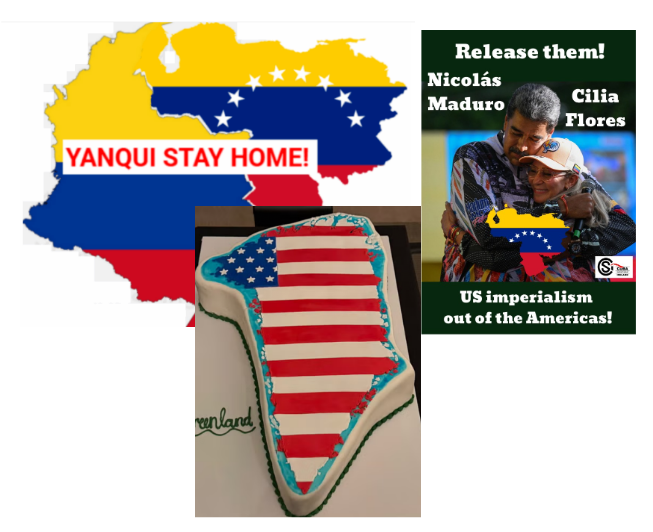
Recent statements made Trump about acquiring Greenland add more confusion to the US current role in world affairs. His threats nearly tore the North American Treaty Alliance (NATO) apart. An attack on one NATO country should trigger a response of all NATO countries. Greenland found itself with the support of some NATO countries, including Denmark, Germany, France, Spain, Italy, the United Kingdom and Poland. Ironically, these same countries let the US threaten and invade non-NATO countries, apparently totally unconcerned about US imperialism. For now, US military action has been averted, but the details of a supposed “agreed upon framework” have yet to be released. One question looms large over all this. Are there any countries left in the world that have a consistent position against US imperialism?
As a recent article titled Venezuela and Iran: A Shared Struggle, posted here: https://uspeacecouncil.org/venezuela-and-iran-a-shared-struggle/ pointed out, Venezuela and Iran are natural allies in this reconfiguration of international relations. Both countries have faced harsh, ongoing sanctions unilaterally imposed on them by the US. Both are sitting on large reserves of oil, a resource coveted by the US. Both have been victims of regime change operations. Iran is still recovering from the overthrow of democratically elected Mosaddegh in 1953 and Venezuela had, up until January 3rd 2026, been able to fight off regime change operations. The first attempt in the 21st century was in 2002 after the election of Hugo Chavez. Pressures continued through the unilateral appointment of Juan Guaidó as president of Venezuela. This was a highly visible, illegal and unsuccessful and embarrassing attempt to wrest power away from Nicolas Maduro. Now, of course, Venezuela is dealing with the totally illegal and dangerous kidnapping of Maduro and first lady Cilia Flores de Maduro. For now, Vice President Delcy Rodriguez of Venezuela is running the country, but Trump could change that at any moment.
What gets lost in all this is the ongoing battle for ownership of Venezuela’s oil reserves and the right for any one country to decide what to do with its own resources. The very thought that Venezuela will have to ask Trump for permission to sell its oil to potential clients is cringe-worthy. This is a decision for Venezuela and only Venezuela to make. A colonizing power that basically took what it wanted from the sovereign government of Venezuela certainly should not have that right.
What seems to be a consistent pattern here is conflict and tension between governance and capitalism’s need to expand markets and make a profit. In the case of the recent kidnapping, some of the largest multinational companies say they want no part of Venezuela’s oil industry because it will require massive investment over a long period of time. But US political leadership seems unfazed. And while Europe and others were frankly shocked and upset at what happened, there seems to be no international attempt to sanction the US or to call for the return of the Maduros to Venezuela. Only anti-imperialist activists from around the world seem to making that demand.
The US actions against Venezuela sparked an immediate and strong response from Colombians and their president Gustavo Petro. Petro had his visa revoked back in September 2025, when he was in New York for a gathering of the United Nations. He spoke at the Ethical Culture Society in New York City and right after he finished that presentation, he was taken to the airport so as not to be in violation of his visa. He made Trump angry for several reasons:
- His unwavering opposition to the genocide in Palestine.
- His interest in bypassing the UN Security Council to get a United for Peace resolution passed through the General Assembly.
- His public statement to the US military that they are not compelled to follow illegal orders.
Back home in Colombia, Petro called simultaneous rallies throughout the country for January 6th, speaking out in defense of national sovereignty, something the US only honors if it applies to themselves. Thousands turned out in support of Petro’s demands, as Colombia gears up for another presidential election. From where this writer sits, here’s hoping that there will be minimal US interference in the results of the election.
And speaking of interference in Latin American elections, one only has to look at Honduras to see what happened there. Juan Orlando Hernandez, who served as a narco-dictator in Honduras for 12 years prior to the election of Xiomara Castro, then convicted of narcotrafficking and sentenced to 45 years in prison was recently pardoned by Trump after serving just 3 years out of the 45. He has already returned to Honduras after the most recent election, undoing years of Honduran struggle to get their country back.
As the whole world is on edge, waiting to see what the US will provoke next, we’re already watching genocides in Palestine, Sudan and the Congo, illegal imperialistic maneuvers in Latin America and elsewhere, brutal Immigration Control and Enforcement raids in places throughout the United States, as crises caused by US imperialism push many to risk their lives to come to the US instead of staying in their home countries to face violence there.
We all need to see these connections and find a way to join together to stop the consequences of US imperialism, at home and abroad.